
Gen Alpha shopping habits are changing the way retailers think about stores, screens and the space in between.
For years, retail has been pushed in one very loud direction: online, faster, cheaper, smoother, more automated. Then along comes the generation raised on YouTube, TikTok, gaming worlds, creator content and instant information – and suddenly the physical store is interesting again.
That does not mean younger shoppers are walking away from digital. Far from it. Their product discovery often starts online, through a creator video, a group chat, a TikTok trend, a YouTube review or a saved post. The difference is that many of them still want the real-life moment after the online spark.
They want to see it, touch it, try it, film it, compare it and share it.
For South African retailers, shopping centres and consumer brands, that matters. The store is no longer only a sales floor. It is a content space, a discovery channel, a trust-builder and sometimes the final push between “I like this” and “I’m buying this.”
TL;DR – key takeaways
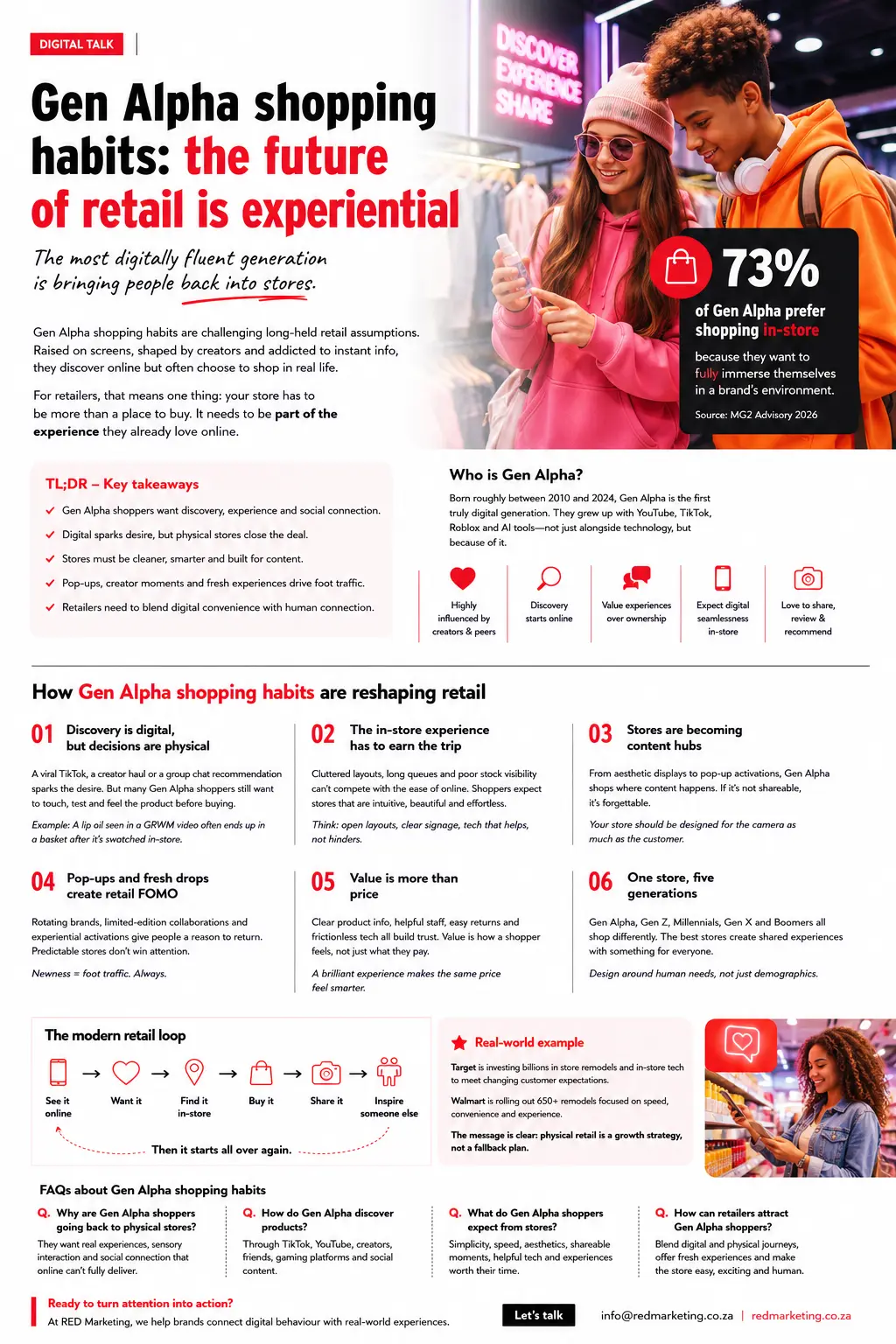
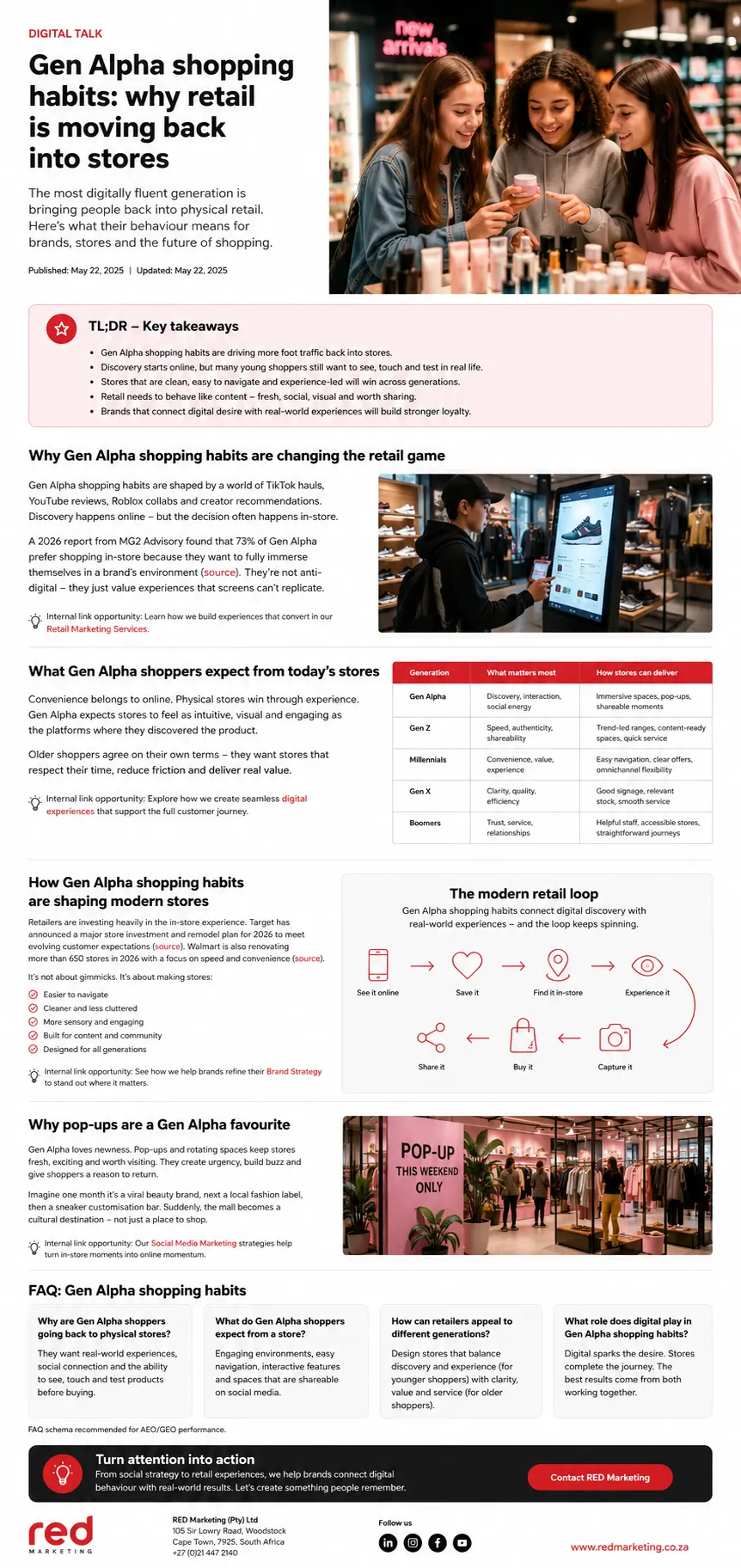
Gen Alpha shoppers may discover products online, but many still want physical, social and sensory in-store experiences before buying. For South African retailers, this means stores need to feel easier to navigate, more visually engaging, more connected to social media and more useful across different generations.
The opportunity is not online versus offline. It is building a retail experience where digital desire and real-world shopping work together.
Why Gen Alpha shopping habits matter for retailers
Gen Alpha is growing up in a world where almost everything can be searched, reviewed, watched or recommended before anyone walks into a store.
That changes the retail journey completely.
A skincare product may be discovered in a GRWM video. A sneaker may be spotted in a creator’s post. A snack, toy, fragrance or fashion item may become desirable because it appears in a trend, not because it was sitting neatly on a shelf.
Then the store steps in.
This is where Gen Alpha shopping habits become especially important. Younger shoppers are often digitally influenced, but physically curious. They may want the product because of what they saw online, but the in-store experience helps them test the choice, validate the hype and enjoy the moment.
For retailers, that means the physical store needs to do more than stock the product. It needs to complete the story.
The store is becoming part of the content journey
In South Africa, malls and shopping centres still play a powerful role in everyday life. They are not only places to shop. They are weekend plans, family stops, food runs, after-school meetups, beauty errands, gifting missions and social spaces.
That gives local retailers a strong advantage, if the experience feels worth the visit.
Gen Alpha shopping habits show that the store can become a natural extension of social media. A display can become a Story. A pop-up can become a TikTok. A product demo can become a shared recommendation. A smart retail moment can move from the shelf to the group chat in seconds.
This is why stores need to be designed with content behaviour in mind.
What will customers photograph?
What will they send to a friend?
What will make them pause?
What will help them understand the product faster?
What will make them want to come back?
Retail spaces that answer those questions well are already thinking beyond foot traffic. They are thinking about attention.
What younger shoppers expect from physical retail
Younger shoppers are used to digital environments that feel fast, visual and easy to explore. That expectation follows them into stores.
They want clear layouts, strong visual cues, helpful product information, easy browsing and moments that feel worth sharing. They also want the freedom to discover without feeling crowded, rushed or confused.
This does not mean every store needs neon lights, selfie mirrors and a DJ booth. Please, no one needs a DJ booth next to the moisturiser unless the moisturiser is having a very big week.
Experience can be much simpler than that.
It can be a cleaner beauty display with testers that make sense. A fashion rail curated by trend or occasion. A pop-up section that changes monthly. A QR code that leads to a tutorial. A product wall that shows bestsellers, new arrivals and staff picks in a way that feels useful.
The point is not noise. The point is relevance.
Why older shoppers still matter
A clever retail strategy cannot only chase the youngest shopper in the room.
Gen Alpha shopping habits are shaping the future, but South African stores also need to serve Gen Z, Millennials, Gen X and Boomers – often in the same shopping trip.
That is where the opportunity becomes more interesting.
Gen Alpha may want discovery, interaction and social energy. Gen Z may want authenticity, speed and shareable moments. Millennials often want convenience, quality and a reason to leave the house. Gen X wants clarity, value and efficiency. Boomers may place more emphasis on service, trust and human support.
One store has to work for all of them.
What different generations want from retail
Generation | What they often want | How stores can respond |
Gen Alpha | Discovery, interaction, social energy | Create hands-on product moments, pop-ups and shareable displays |
Gen Z | Speed, authenticity, trend relevance | Use clear merchandising, creator-led cues and easy social integration |
Millennials | Convenience, value, experience | Make the visit efficient, attractive and genuinely worth the trip |
Gen X | Clarity, quality, ease | Improve signage, service, stock visibility and navigation |
Boomers | Trust, service, familiarity | Offer helpful staff, simple journeys and clear product guidance |
The best retail experiences do not design around age alone. They design around human behaviour: people want ease, clarity, relevance and a reason to care.
How global retail investment signals a bigger shift
This is not only a small trend playing out in youth culture. Major retailers are investing heavily in physical stores again.
Target has announced significant investment into store remodels, technology, supply chain and guest experience. Walmart has also announced hundreds of store remodels focused on speed, convenience and growth.
Those moves are worth watching from South Africa because they show a broader shift in retail thinking. Physical stores are not being treated as leftovers from the pre-digital era. They are being reworked as strategic customer experience spaces.
For local retailers, the lesson is clear: stores need to feel modern, useful and connected to the way people already behave online.
That does not always require a massive renovation. It may start with better product zones, improved signage, cleaner pathways, smarter displays, staff training, better social media integration or more regular in-store activations.
Small changes can make a store feel much more alive.
Why pop-ups and rotating experiences work
Pop-ups are powerful because they give people a reason to visit now.
Digital platforms have trained younger audiences to expect newness. New drops. New creators. New trends. New formats. New edits. When a store looks identical every time someone visits, it can start to feel invisible.
Rotating retail moments help solve that.
A shopping centre could introduce a rotating local brand space. A beauty retailer could launch a monthly trend table. A fashion store could create a limited seasonal edit. A food brand could run tasting moments linked to social content. A homeware store could build a “seen online” section that brings digital demand into the aisle.
The magic is in the return reason.
A customer who thinks “I wonder what’s there this month?” is far more valuable than a customer who assumes the store will always look the same.
The modern retail loop
The modern customer journey rarely moves in a straight line.
It often looks more like this:
- A creator posts a product
- A shopper saves it
- A friend mentions it
- The shopper sees it in-store
- They test it or try it
- They buy it
- They post it
- Someone else discovers it
That is the modern retail loop.
For South African brands, this loop is especially useful because it connects social media, content creation, retail merchandising, influencer marketing and in-store experience into one customer journey.
When those pieces work together, a store visit does not end at the till. It becomes part of the next person’s discovery journey.
What South African retailers should do next
Retailers do not need to redesign everything overnight. They need to look at the store with fresh eyes.
Start with the shopper journey. Is it clear where to go? Is the product easy to understand? Does the space feel current? Are the best products easy to find? Is there anything worth photographing, sharing or talking about? Does the in-store experience match the promise being made online?
Then look at how your digital channels support the store.
Are you showing what is available in-store? Are you using social media to build desire before people arrive? Are you promoting new arrivals, activations, pop-ups and limited offers in a way that creates urgency? Are you giving customers reasons to visit beyond price?
Gen Alpha shopping habits are a reminder that physical retail still has a future, but only if the experience earns attention.
Boring stores will struggle. Useful, social, easy-to-navigate, content-ready stores have a much better shot.
FAQs about Gen Alpha shopping habits
What are Gen Alpha shopping habits?
Gen Alpha shopping habits refer to the way younger consumers discover, evaluate and engage with products. Their discovery often starts online through creators, social media, video content and peer recommendations, but many still value physical stores where they can see, touch, test and experience products.
Why do Gen Alpha shoppers still like physical stores?
Gen Alpha shoppers often enjoy physical stores because they offer sensory experience, social interaction and instant discovery. Stores give them a way to validate what they have seen online and turn digital interest into a real-world shopping moment.
How can South African retailers attract Gen Alpha shoppers?
South African retailers can attract Gen Alpha shoppers by creating stores that are easy to navigate, visually engaging, connected to social media and regularly refreshed through pop-ups, product edits, demos or creator-led moments.
Does Gen Alpha prefer online or in-store shopping?
Gen Alpha does not fit neatly into one channel. Their shopping journey often blends online discovery with in-store experience. The strongest retail strategies connect digital content, social proof and physical shopping into one journey.
What role does social media play in Gen Alpha shopping habits?
Social media plays a major role in product discovery. Platforms such as YouTube, TikTok and Instagram influence what younger shoppers notice, want, save, share and eventually look for in-store.
Need help turning retail attention into action?
At RED Marketing, we help brands connect digital behaviour with real-world customer experience – from social media strategy, content creation and paid advertising to brand storytelling, website journeys, influencer marketing and retail-led campaigns.
If your store, centre or consumer brand needs a sharper way to turn attention into visits, clicks and conversions, let’s talk.
Email: info@redmarketing.co.za