
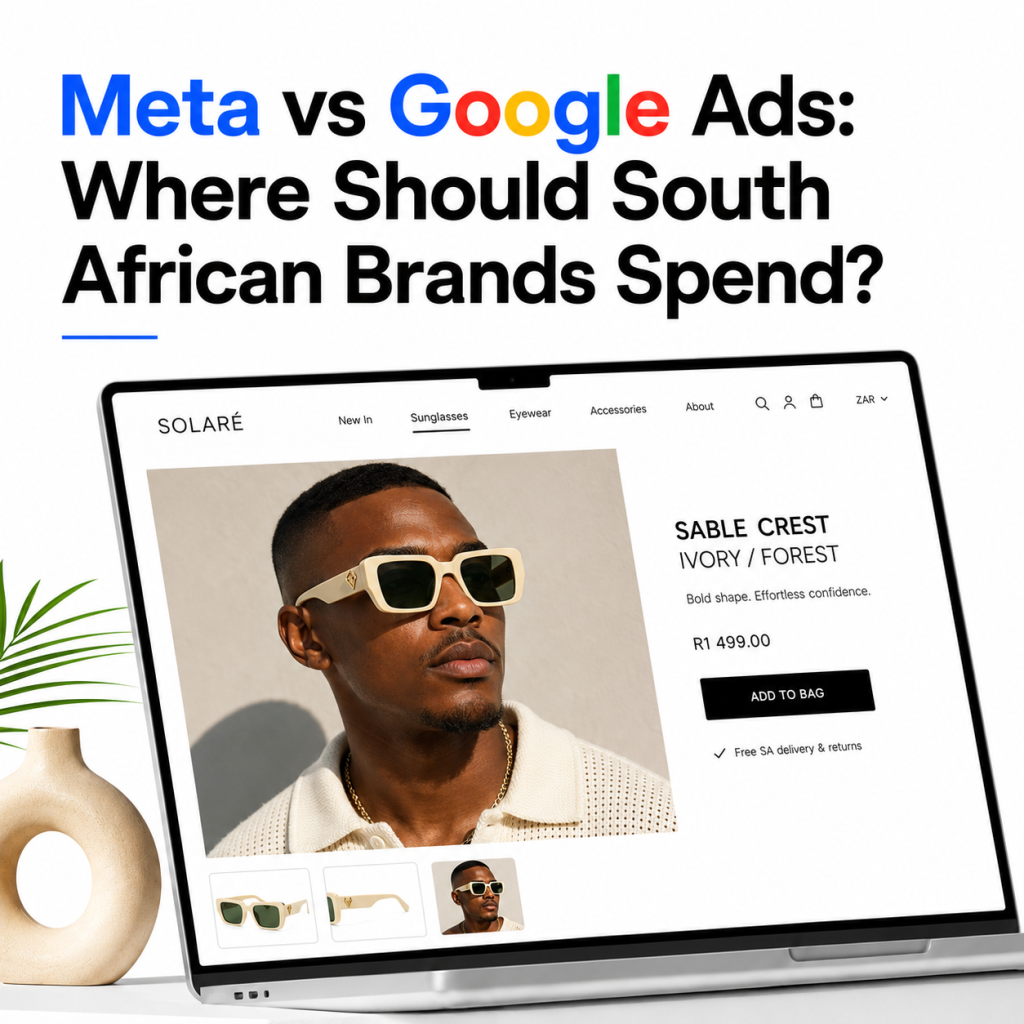
Meta vs Google Ads: Where Should South African Brands Spend?
Meta vs Google Ads is: A customer discovers a pair of sunglasses on Instagram, sends the post to a friend on WhatsApp, searches the brand on Google later that evening and finally makes a purchase through the website.
So, which platform made the sale?
That question sits at the centre of the Meta vs Google Ads debate. Google is brilliant at responding when someone is already searching. Meta is increasingly effective at creating the interest that causes the search to happen in the first place.
The distinction matters for South African businesses trying to decide where their next rand of advertising budget should go.
Meta is forecast to overtake Google in global net digital advertising revenue during 2026. EMARKETER expects Meta to generate approximately $243.46 billion, compared with Google’s projected $239.54 billion. This is still a forecast rather than a completed full-year result, but it reflects a significant change in how advertisers are allocating money.
Google is not disappearing. Far from it. What is changing is the route consumers take between seeing something, wanting it and eventually buying it.
Key takeaways
- Meta is strong at introducing products and generating demand.
- Google is strong at capturing existing search intent.
- South African campaigns need to account for mobile browsing and social discovery.
- WhatsApp can shorten the path between advertising and enquiry.
- Creative quality, landing pages and lead follow-up matter as much as platform choice.
- Many brands will achieve better results by using Meta and Google together.
What the Meta vs Google Ads headline actually means
The podcast conversation that inspired this article argued that Google’s search-driven advertising model can feel less dynamic than Meta’s ability to find people based on their interests and online behaviour. It also suggested that social adverts can feel more natural because they appear between the content people have already chosen to watch.
There is truth in thheadline needs context.
Meta has not yet officially reported higher annual advertising revenue than Google. The forecast compares net digital advertising revenue, which accounts for certain traffic and content-acquisition costs. It is not identical to simply placing the two companies’ reported figures next to each other.
Both businesses are still growing. Meta reported $55.02 billion in advertising revenue for the first quarter of 2026, representing 33% year-on-year growth. Google Search and other advertising revenue grew by 19% during the same quarter, while YouTube advertising increased by 11%.
This is not a story about Google collapsing. It is a story about social advertising becoming powerful enough to challenge search at a global level.
Why Meta advertising suits the South African market
South Africa is a deeply connected market. At the end of 2025, the country had approximately 51.7 million internet users and 29.1 million social media user identities. Facebook’s potential advertising reach was equivalent to 53.9% of the local internet population, while Instagram’s potential South African audience had grown by 19.4% over the preceding year.
Those figures help explain why Meta has become such an important commercial channel locally. Consumers do not only use social platforms to keep up with friends. They discover restaurants, clothing, cars, beauty products, travel experiences and professional services there too.
Meta creates interest before the customer starts searching
Google generally works best after someone has decided to look for something.
A person might search for:
- “Dentist near Sandton”
- “Best solar installer Johannesburg”
- “Car service centre Durban”
- “Luxury guesthouse Franschhoek”
- “Order skincare online South Africa”
The search itself shows intent.
Meta reaches people earlier. Someone may not be actively searching for a new restaurant, holiday destination or pair of sunglasses. A strong Reel or carousel can introduce the idea and move the product onto their radar.
This makes Meta particularly useful for categories that depend on visual impact, personality or aspiration.
Fashion, restaurants, skincare, property, hospitality, automotive and events all benefit from creative that can make a person stop scrolling and think, “I need to know more about that.”
Meta can find audiences beyond obvious interests
Advertisers once built Meta campaigns by manually selecting long lists of interests and demographic characteristics.
That approach has changed.
Meta’s Advantage+ tools use automation across audience selection, placements and campaign budgets. The system is designed to match adverts with people considered more likely to take a relevant action, while still allowing advertisers to set important boundaries such as location.
For a South African business, that can mean giving Meta a clear commercial objective and allowing the platform to test which people, placements and pieces of creative produce the best response.
The technology makes campaign setup easier. It does not make strategy unnecessary.
Meta still needs:
- A clear offer
- Strong, varied creative
- Accurate conversion tracking
- Enough budget and time to learn
- A website or enquiry process that works
- Fast lead follow-up
The algorithm can find opportunities. It cannot fix an unclear brand or a clumsy buying experience.
WhatsApp can reduce the distance between interest and action
For many South African businesses, the final conversion does not happen through an online checkout.
It happens through a conversation.
A customer sees an advert, taps a button and asks about pricing, availability, finance, an appointment or a quotation. Meta allows adverts on Facebook and Instagram to open conversations directly in WhatsApp, Messenger or Instagram Direct.
This can be particularly useful for:
- Motor dealerships
- Medical and aesthetics practices
- Property businesses
- Restaurants and venues
- Trades and home services
- High-value products requiring consultation
- Businesses where customers want reassurance before buying
However, a WhatsApp campaign is only as strong as the response process behind it.
If an enquiry arrives at 10:00 and receives a reply at 16:30, the media campaign may have done its job while the sales process loses the opportunity.
Why Google Ads still matters in South Africa
Meta may be growing faster, but Google retains one enormous advantage: it captures people who are already looking.
That makes it particularly valuable for urgent, local or high-consideration purchases.
Google captures immediate need
Someone whose geyser has burst is unlikely to wait for a plumbing Reel to appear in their feed.
They will search.
The same is true when a consumer needs:
- A nearby doctor
- A mechanic who can help today
- A supplier for a specific industrial component
- A lawyer specialising in a particular matter
- Accommodation in a particular town
- A retailer stocking a specific product
Google Ads allows the business to appear while that need is active.
The customer may never have heard of the brand before, but a relevant advert, credible website and strong review profile can still win the enquiry.
Google supports considered research
Not every Google search is urgent.
South Africans also use search to compare vehicles, investigate medical treatments, assess schools, research financial services and evaluate major purchases. These customers may visit several websites, read reviews and return more than once before making contact.
Google can therefore play a role throughout the research process, particularly through Search, Shopping, Performance Max and YouTube.
Meta may introduce the possibility. Google often helps validate it.
Meta vs Google Ads by business type
South African business | Meta Ads opportunity | Google Ads opportunity |
Fashion or ecommerce brand | Product discovery, Reels and remarketing | Shopping searches and branded intent |
Restaurant or hospitality venue | Visual storytelling and offers | Location, menu and booking searches |
Medical or aesthetics practice | Education, trust and lead generation | Treatment and practitioner searches |
Motor dealership | Vehicle offers, lead forms and WhatsApp | Model, dealership and price searches |
Professional service firm | Awareness and thought leadership | High-intent service searches |
Home services business | Local awareness and retargeting | Urgent “near me” searches |
Property business | Lifestyle creative and lead generation | Development, area and agent searches |
Event or experience | Excitement, video and social proof | Date, venue and ticket searches |
The table is not a fixed rule. A strong campaign depends on how people buy within the category, how competitive the market is and whether the business has enough creative and tracking infrastructure to support the channel.
The biggest problem may not be the advertising platform
Businesses often blame Meta or Google when the real issue sits somewhere else.
The advert might be generating the right traffic, but the next step is failing.
Common problems include:
- A website that loads slowly on mobile
- A landing page that does not match the advert
- No visible pricing guidance
- A weak or confusing call to action
- Forms asking for too much information
- Poor reviews or limited trust signals
- Leads receiving slow responses
- Sales teams failing to record outcomes
- Campaigns being judged on clicks rather than revenue
South Africa recorded 127 million active cellular connections at the end of 2025, while 98.7% of those connections were capable of using 3G, 4G or 5G networks. This makes mobile experience a critical part of campaign planning.
A beautiful desktop website that becomes awkward on a phone is not ready for serious advertising.
Should South African businesses choose Meta or Google?
The honest answer is that it depends on where the customer is in the buying journey.
Choose Meta when the business needs to create demand
Meta is likely to be valuable when:
- The product needs to be seen to be understood
- The audience is broad or lifestyle-driven
- The business has strong video and image content
- Social proof influences the decision
- The objective is awareness, leads or online sales
- WhatsApp is an important enquiry channel
- Remarketing can help move undecided customers closer to action
Choose Google when the business needs to capture demand
Google is likely to be valuable when:
- Customers actively search for the service
- The need is urgent or location-based
- The offering solves a clearly defined problem
- Search terms reveal strong commercial intent
- The purchase involves comparison and research
- The brand needs to protect its own branded searches
Use both when discovery and intent overlap
A customer journey might look like this:
- A person sees a Meta advert for a vehicle.
- They watch a second Reel from the dealership.
- They visit the website but do not enquire.
- They later search the model on Google.
- A search advert brings them back to a dedicated landing page.
- They tap through to WhatsApp.
- The dealership follows up and books a test drive.
Which platform generated the lead?
Both contributed. The creative created interest. Search captured intent. WhatsApp made the enquiry easy. The sales team closed the gap.
That is a more useful way to understand Meta vs Google Ads than simply asking which platform is bigger.
Do not split the budget blindly
Dividing a budget equally between Google and Meta may look balanced, but it is not automatically strategic.
The media mix should reflect:
- Existing search demand
- The average value of a sale
- The length of the decision-making process
- Geographic targeting
- The strength of the creative assets
- Website conversion rates
- Sales capacity
- Campaign data from previous months
A new product with no search volume may need Meta to introduce it.
An emergency service may need Google first.
An ecommerce business may require Meta for discovery, Google Shopping for active buyers and remarketing across both platforms.
The objective should determine the channel. Not the latest industry headline.
The South African advantage is integration
The strongest campaigns do not treat paid media as a collection of isolated adverts.
Meta, Google, SEO, website content, WhatsApp, reviews and sales follow-up should reinforce one another.
At RED Marketing, we look at the entire path:
- Where does the customer first notice the brand?
- What makes them trust it?
- Where do they search for more information?
- What stops them from enquiring?
- How quickly does the business respond?
- Which leads become customers?
- Which campaigns produce revenue rather than activity?
Our performance marketing approach brings paid media, creative, search visibility and website conversion together rather than expecting one platform to carry the full weight of the strategy. RED’s existing South African performance work similarly combines Meta, Google Ads, landing pages, content and lead optimisation.
The final verdict
Meta is becoming more powerful because it can generate demand while people are consuming content.
Google remains powerful because it captures demand when people decide to search.
For South African brands, the smartest answer is rarely “Meta instead of Google” or “Google instead of Meta”.
It is:
Use Meta to make people interested. Use Google to be there when that interest becomes intent.
The platform receiving the biggest global advertising forecast is interesting.
The platform combination generating the best local business result is far more important.
Frequently asked questions
Is Meta advertising better than Google Ads in South Africa?
Meta is often stronger for visual discovery, awareness, ecommerce and lead generation. Google is often stronger when people are already searching for a specific product, service or location. The right choice depends on the customer’s intent.
Has Meta officially overtaken Google?
Not yet. EMARKETER forecasts that Meta will overtake Google in net worldwide digital advertising revenue during 2026. The comparison remains a projection until the full-year figures are available.
Can Meta Ads send customers to WhatsApp?
Yes. Meta’s click-to-message adverts can send people from Facebook or Instagram into a WhatsApp conversation with the business.
Which platform is cheaper?
Neither platform is always cheaper. Costs depend on the industry, audience, location, competition, campaign objective, creative quality and conversion rate. Cost per qualified lead or sale is more useful than cost per click alone.
Should a small South African business use both?
Using both can work well when the platforms perform different jobs. Meta can introduce the business and create interest, while Google captures customers who later search for the service or brand.