
South African Nano Influencers: Why Local Relevance Wins
South Africa is not one market, one culture or one neatly packaged audience. That is precisely why South African nano influencers can be so valuable.
A creator with a few thousand highly relevant followers in Johannesburg, Cape Town, Durban, Gqeberha or a particular interest community may deliver more meaningful attention than a national personality whose audience is much larger but far less specific.
The opportunity is not simply to find cheaper influencers. It is to work with credible local creators who understand the people, places and everyday realities surrounding a brand.
What you need to know: South African Nano Influencers
- Nano influencers generally have between 1,000 and 10,000 followers
- Local relevance can matter more than national reach
- South African creator pricing should be based on performance, content and usage rights – not follower count alone
- Gifted products do not guarantee coverage
- Paid and gifted partnerships must be clearly disclosed
- The strongest campaigns connect influencer content to a measurable next step
What are South African nano influencers?
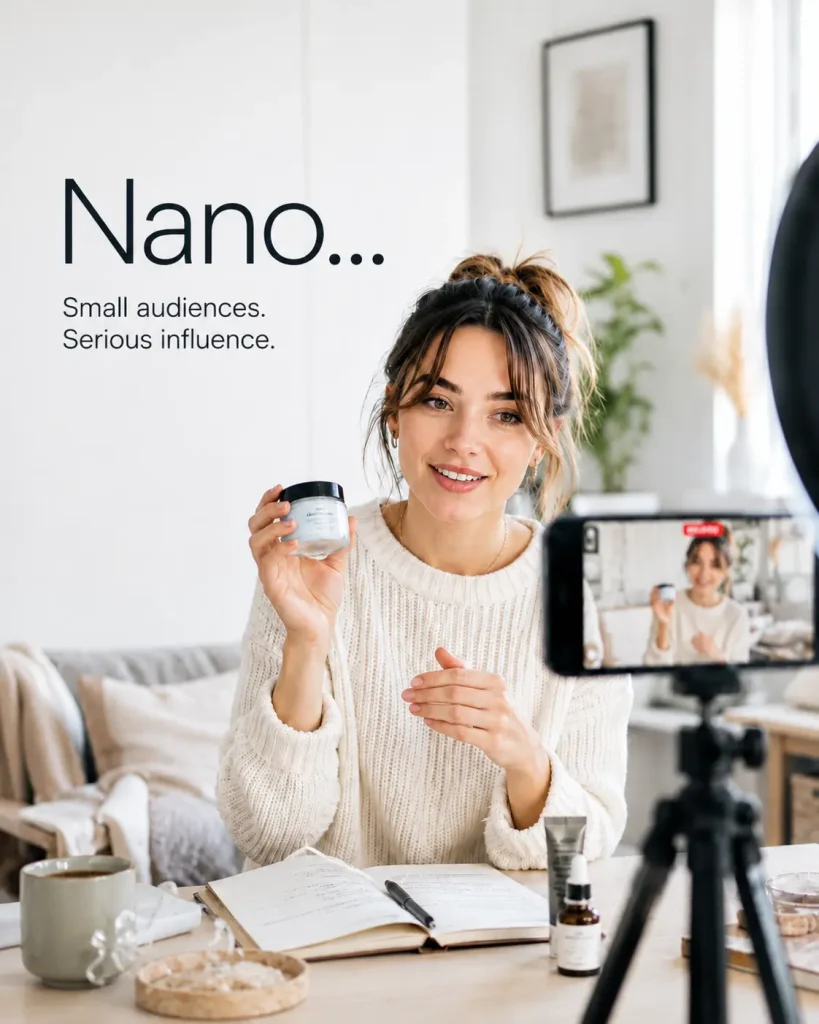
Nano influencers are generally defined as creators with between 1,000 and 10,000 followers. The exact threshold varies between platforms and agencies, but the term usually describes smaller creators with focused communities rather than mass-market reach.
South African brands are showing growing interest in this tier. One local industry report found that 44% of surveyed brands were working with nano influencers, compared with 26% using micro-influencers.
That does not mean every small account is influential.
A creator becomes commercially useful when they have built trust around a recognisable subject, community, location or point of view. A local food reviewer, township fashion creator, skincare educator, family travel account or running-club organiser may each influence a very different type of decision.
Their strength lies in specificity.
Why local influence matters in South Africa
A national follower count can conceal enormous differences in who is actually paying attention.
Two creators with the same number of followers may have completely different value to a brand because of:
- Where their followers live
- Which languages they use
- The age and income profile of the audience
- The communities they understand
- The platforms their followers prefer
- Whether the content reflects real purchasing circumstances
A restaurant in Rosebank does not benefit greatly from reaching thousands of people who live too far away to visit. A regional fashion launch may need creators whose followers live in the relevant cities. A skincare brand may need different voices for teenage acne, sensitive skin, mature customers and value-conscious shoppers.
Localisation is not achieved by adding “Mzansi” to a caption and hoping for the best.
It comes from choosing people who understand how the audience speaks, shops, travels, compares prices and makes decisions.
South Africans are already looking to creators and brands online
South Africa has an unusually active social media audience.
At the beginning of 2025, approximately 26.7 million South Africans aged 18 and older were using social media. The average internet user spent around three hours and 36 minutes a day on social platforms.
The commercial opportunity is equally important:
- 63% of South African users visited social media to seek out brand content
- 6% used social media for inspiration about things to do and buy
- 6% followed influencers and online experts
These figures do not prove that every influencer campaign will work. They do show that creators are operating where many South Africans already discover, research and discuss products.
The question is not whether people are online.
It is whether the brand is appearing through voices they consider relevant.
What do nano influencers do particularly well?
South African nano influencers tend to be most useful when a campaign needs targeted attention, relatable content or community-level credibility.
They can make national brands feel local
A national campaign does not always need one national voice.
A group of creators from different provinces, cities or communities can interpret the same campaign through different lived experiences. The message remains consistent, while the delivery feels less generic.
They can help smaller businesses compete
Many SMEs cannot afford celebrity endorsements or large-scale media campaigns.
Nano partnerships can provide an accessible way to introduce products, generate content and test audience response without placing the entire budget behind one person.
The lower individual cost does not mean the campaign should be casual. Smaller creators still require proper selection, briefing, contracting and reporting.
They can explain products naturally
Creators are particularly useful when a product needs demonstration or context.
This could include:
- Showing how a skincare product fits into a routine
- Reviewing a restaurant experience
- Styling locally made clothing
- Demonstrating an app or service
- Taking followers through a hotel or destination
- Explaining how a specialist product is used
- Sharing a genuine customer experience
The content works because it shows the product in use rather than simply announcing that it exists.
They can produce varied content
Working with several creators gives the brand access to different voices, formats and creative interpretations.
That content may later support the brand’s own social channels or paid advertising – provided the appropriate usage rights have been agreed.
Which South African businesses can benefit?
Nano influencer campaigns can work across a wide range of categories, but they are especially suited to businesses where location, lifestyle or product experience influences the decision.
Tutorials, routines, demonstrations and honest product experiences translate naturally into creator content.
Brands must still control claims carefully. Influencers should not make medical, therapeutic or guaranteed-result claims that cannot be supported.
Local food and lifestyle creators can build awareness around openings, menus, seasonal offers and experiences.
The audience location matters enormously. A strong national following is less useful when the campaign needs bookings in one neighbourhood.
Nano creators can show how products look, fit and work in real life. They can also help emerging designers or retailers reach specific style communities without immediately competing for celebrity attention.
Tourism and experiences
Smaller travel and lifestyle creators can communicate the details that matter to customers – what the experience feels like, who it suits and whether it represents value.
Fitness and wellness
Creators associated with particular sports, studios or wellness communities may offer a closer relationship with the audience than general lifestyle accounts.
Automotive and local services
A relevant creator can introduce a dealership, workshop, service or vehicle experience to a geographically defined audience.
The fit must be credible. A creator who has never shown any interest in cars will not suddenly become an automotive authority because someone handed them a set of keys.
How much do South African nano influencers charge?
There is no reliable universal rate card for South African creators.
Humanz’s 2026 South African benchmark report notes that median cost-per-thousand impressions and cost-per-engagement figures have begun to stabilise, while also stressing the need to assess pricing by category.
That is a more useful approach than pricing solely according to follower count.
A creator’s fee can be influenced by:
- Average views and reach
- Engagement quality
- Audience location
- Platform
- Content format
- Filming and editing requirements
- Travel and event attendance
- Turnaround time
- Number of revisions
- Exclusivity
- Usage rights
- Paid media amplification
The length of the campaignA creator with 5,000 followers and consistently strong video views may be more valuable than one with 20,000 followers whose content reaches very few people.
Budget for the complete campaign
The creator fee is only one part of the cost.
A realistic budget may also need to cover:
- Product and delivery
- Travel or accommodation
- Campaign management
- Contracts and administration
- Photography or production support
- Paid amplification
- Tracking links or landing pages
- Content licensing
- Reporting and analysis
Cheap content that does not reach the right people is not economical. It is merely cheap.
Gifted products do not guarantee content
Product gifting is widely used in South African influencer campaigns, particularly in beauty, food, fashion and lifestyle.
However, sending a product does not automatically create an obligation to post.
There is an important difference between:
Unconditional gifting – the creator receives a product without promising content.
A gifted collaboration – the creator agrees to produce defined content in return for the product or service.
A paid collaboration – the creator is paid for agreed deliverables.
An affiliate partnership – the creator earns commission from tracked sales or leads.
Brands should be explicit about which model applies.
A gifting programme can help develop relationships and product awareness, but it should not be presented internally as guaranteed media coverage unless the creator has agreed to deliver it.
How to choose the right South African nano influencers
Creator selection should start with the audience and campaign objective.
Check the audience location
A creator may live in South Africa while attracting a large international following.
Request recent audience insights showing countries, cities and demographic information where relevant. For location-based campaigns, this can be more important than total follower count.
Consider language and cultural context
The creator should be able to communicate naturally with the intended audience.
That may involve language, humour, cultural references, community knowledge or simply an understanding of the customer’s daily reality.
The brand should not force a creator to perform a version of local identity that does not belong to them.
Review average performance
Do not judge the account by one viral post.
Examine a representative selection of content and consider:
- Average video views
- Post reach
- Story views
- Saves and shares
- Comment quality
- Audience growth
- Sponsored-content performance
Read the comments
Comments reveal whether followers are genuinely paying attention.
Useful engagement may include questions, personal experiences, recommendations and discussion. Generic praise or repeated emoji responses offer less evidence of influence.
Assess content quality
Raw does not mean careless.
The creator should be able to produce content that is clear, watchable and appropriate for the platform. Audio, lighting, editing and storytelling still matter, even when the style is informal.
Review previous partnerships
Look at the number, frequency and type of sponsored posts.
Check whether the creator has recently worked with competitors, whether commercial content feels believable and whether advertisements are disclosed correctly.
Evaluate professionalism
A good nano creator should be able to confirm:
- Deliverables
- Timelines
- Fees
- Approval requirements
- Usage rights
- Reporting
- Disclosure
A small audience is not an excuse for unclear commercial arrangements.
Choosing the right platform
Platform selection should follow the campaign objective rather than whichever app is currently receiving the most attention.
TikTok
TikTok is useful for discovery, entertainment, demonstrations and highly shareable short-form video. It was used by 69% of South African brands participating in one industry survey, ahead of Instagram, YouTube and Facebook.
Instagram remains useful for visual storytelling, Reels, Stories, product launches and maintaining a strong creator portfolio.
YouTube
YouTube suits longer demonstrations, reviews, education and content that may continue appearing in search results long after publication.
Facebook can remain valuable for older audiences, local communities, events and geographically focused businesses.
WhatsApp is not usually the public home of an influencer campaign, but it can be a powerful conversion destination.
A creator can direct interested followers towards a WhatsApp enquiry, booking or sales conversation. The response process then needs to be quick, organised and measurable.
South African influencer advertising rules
Paid influencer content must be clearly identifiable as advertising.
The Advertising Regulatory Board’s Social Media Code requires marketers to disclose paid social media advertising when it might otherwise appear to be the creator’s unsolicited opinion. Recognised identifiers include #AD, #Advertisement and #Sponsored.
The Code also requires disclosure when goods or services have been provided in return for coverage. It prohibits deceptive, false or misleading content.
Brands should make disclosure part of every brief and contract.
A clear disclosure should be:
- Easy to see
- Included within the content
- Placed before a long block of hashtags
- Used on relevant Story frames
- Visible in video content
- Applied to gifted and paid partnerships where required
A vague thank-you to the brand is not the same as clearly identifying a commercial relationship.
How to brief creators without removing their personality
A useful brief protects the campaign without turning the creator into a corporate spokesperson.
It should include:
- The campaign objective
- Intended audience
- Product facts
- Agreed deliverables
- Key dates
- Required disclosures
- Mandatory information
- Claims that may not be made
- Approval arrangements
- Usage rights
- Reporting requirements
- The desired call to action
The brief should not dictate every word.
The point of hiring a creator is to access a voice and relationship the brand does not own. If the final content sounds exactly like the company brochure, something has gone wrong.
How should influencer campaigns be measured?
The correct measurement depends on what the campaign was designed to achieve.
Awareness
Track:
- Relevant reach
- Video views
- Watch time
- Audience location
- Frequency
- Brand mentions
Engagement and consideration
Track:
- Saves
- Shares
- Meaningful comments
- Story replies
- Profile visits
- Website visits
- Direct enquiries
Leads and sales
Track:
- Unique links
- Discount codes
- WhatsApp enquiries
- Bookings
- Sign-ups
- Purchases
- Cost per lead
- Cost per acquisition
Content value
Track:
- Number of usable assets
- Organic content performance
- Paid advertising performance
- Production costs
- Usage period
- Content variations created
Measurement in South Africa can be complicated by offline purchases and fragmented customer journeys. Humanz’s 2026 research highlights this attribution gap and recommends building systems that continue learning even when every conversion cannot be tracked perfectly.
Imperfect tracking is not a reason to avoid measurement altogether.
Common nano influencer marketing mistakes
The most expensive mistakes often happen before the creator posts anything.
These include:
- Choosing creators based only on follower count
- Ignoring audience geography
- Treating gifting as guaranteed coverage
- Failing to agree on usage rights
- Using vague or over-scripted briefs
- Forgetting disclosure requirements
- Measuring likes instead of business outcomes
- Paying for content the brand cannot reuse
- Expecting one post to deliver long-term sales
- Responding slowly when enquiries arrive
The strongest campaigns are not improvised after a creator has been selected. They are planned backwards from the intended result.
Small creators can carry a very local kind of influence
South African nano influencers are valuable because they can speak to defined communities with context that mass communication often misses.
That does not make them automatically trustworthy, affordable or effective. Brands still need research, clear agreements, credible content and meaningful measurement.
The opportunity is not to replace every large creator with ten small ones.
It is to stop treating follower count as the strategy.
At RED Marketing, we help brands identify, approach and manage suitable creators through our PR and influencer marketing services. We connect influencer campaigns with social media strategy, content creation, public relations and paid media, so the attention generated has a clear route towards enquiry, booking or purchase. RED Marketing’s South African service offering already includes influencer relations, campaign strategy, creative support and performance reporting.
Because local influence is not about speaking to everyone.
It is about being believed by the people who matter.
Frequently asked questions
How many followers does a nano influencer have in South Africa?
A nano influencer generally has between 1,000 and 10,000 followers. The definition may vary slightly between platforms and influencer agencies.
Are nano influencers cheaper than celebrity influencers?
Their individual fees are generally lower, but a campaign involving many nano creators can require more management, delivery, contracting and reporting. The total cost should be assessed against the campaign outcome.
Do gifted influencer posts need to be disclosed?
The ARB Social Media Code requires creators to disclose when goods or services have been provided in return for media coverage.
Which platform is best for South African influencer marketing?
It depends on the audience and objective. TikTok is strong for discovery and short-form video, Instagram for visual storytelling, YouTube for detailed content and Facebook for local communities and older audiences.
How can a brand tell whether an influencer has a South African audience?
Ask for recent platform analytics showing audience countries, cities and demographics. Do not assume audience location from the creator’s biography.
How should brands measure a nano influencer campaign?
Measure relevant reach, engagement quality, clicks, enquiries, bookings, sales, cost per acquisition and the value of reusable content. The metrics must connect to the original campaign objective.